Páginas

Bienvenidxs al blog de Alberto


EN LIBERTAD EL 31 DE OCTUBRE 2013
Mostrando las entradas con la etiqueta M. English. Mostrar todas las entradas

After 13 years, Patishtán returns to El Bosque

Foto
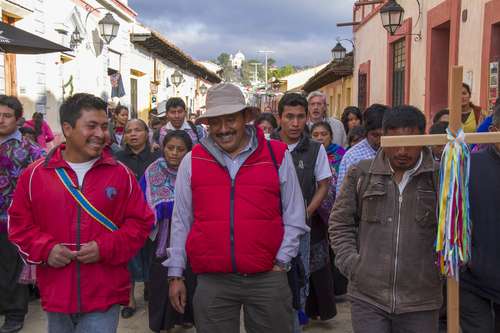
Alberto Patishtán Gómez regresó el domingo, después de 13 años de carcel, a su pueblo natal, El Bosque, en ChiapasFoto Moysés Zúñiga Santiago

*He is a disgrace to the authorities
Alberto Patishtán Gómez returned to his birthplace, El Bosque, in Chiapas, on Sunday after 13 years in prison. Photo: Moysés Zúñiga Santiago
Hermann Bellinghausen
La Jornada, Tuesday 2nd November, 2013

San Juan El Bosque, Chiapas - Speaking of his long captivity, Alberto Patishtán says to the small crowd who welcome him home: "They were thirteen years of living death. But instead of dying, I was returned to life. Instead of keeping silent, I learned to speak. We are poor, but rich in principles and values, in dignity and respect. We know how to resist, and how to insist on justice."
The multitudes of the Tzotzil people of El Bosque welcomed their most famous and admired son. After his thirteen-year absence, today the villagers gave Patishtán Gómez a forceful and moving presence. Since morning, here they have done nothing but welcome him. They accompanied him through the streets. They gave him countless hugs. There were Catholic prayers and songs, rockets, speeches, and thanks for the powerful meat of three bulls slaughtered for the occasion. The teacher said, "I'm not just content, but happy." His compañero from many battles, the teacher Martin Ramírez, said on behalf of the El Bosque Movement in Defence of the People: "Everybody wins, we are celebrating a victory."

The Presidential Pardon does not end the Struggle for the Liberty of Indigenous Prisoners - Alberto Patishtán

Proceso, 30th November, 2013
From the Editorial Board
After spending thirteen years in prison, on Saturday the Tzotzil teacher Alberto Patishtán arrived in Tuxtla Gutierrez, Chiapas; there he said that the fight for the freedom of the indigenous, who are unjustly imprisoned, did not end with the presidential pardon.
On October 31st, President Enrique Peña Nieto confirmed his decision to pardon Patishtán Gómez and notified his immediate release.

“The Struggle Doesn’t End Here; it begins here,” says Patishtán on arriving in San Cristóbal

Foto
El profesor tzotzil Alberto Patishtán Gómez al arribar ayer a San Cristóbal de las Casas, Chiapas Moysés Zúñiga SantiagoFoto Moysés Zúñiga Santiago
By: Hermann Bellinghausen, La Jornada, 1st December, 2013
San Cristóbal de las Casas, Chiapas, November 30, 2013
“The struggle doesn’t end here. It begins here.” With these words Professor Alberto Patishtán Gómez arrived in Chiapas, free for the first time in 13 years. Around a hundred indigenous people received him. They were from the Catholic organization Pueblo Creyente (Believing People) and from the Movement of the People of El Bosque, which has demanded the Tzotzil teacher’s freedom for more than a decade.
After coming from Mexico City, Patishtán left the Ángel Albino Corzo Airport at 12:30 PM. Representatives of the communications media surrounded him immediately. Once outside, his people greeted him with affection; he received the first hugs from his Aunt María, his grandfather and other family members and neighbours.

Mexico to pardon indigenous teacher Alberto Patishtan


Mexican indigenous teacher Alberto Patishtan is seen in jail in San Cristobal de las Casas on 13 September, 2013
BBC 

Mexican President Enrique Pena Nieto says he will pardon an indigenous teacher serving a 60-year jail term.

Alberto Patishtan, 41, was convicted in 2002 for the murder of seven policemen in southern Chiapas state during the Zapatista rebel uprising.

President Pena Nieto said he would pardon him under a new law which widens the scope of executive reprieves.
Human rights groups have argued that Patishtan's trial was flawed and beset by irregularities.
President Pena Nieto said on his Twitter account that the pardon would come into effect on Thursday, when the new law comes into force.

President Peña Nieto Will Pardon Alberto Patishtán

Rosa Elvira Vargas, Fernando Camacho and Emir Olivares

La Jornada, 30th October, 2013

President Enrique Peña Nieto has announced his decision to pardon Alberto Patishtán on Thursday, once reforms to the Federal Criminal Code approved by the Legislature enter into force.

Today Wednesday [October 30, 2013] the Code's reforms, passed by the Senate and ratified yesterday by the Chamber of Deputies, will be published in the Official Journal of the Federation.

In his Twitter account, the President issued two messages last night to introduce these measures:

"The day after tomorrow I will publish at @ DOF SEGOB the Reforms to the Federal Criminal Code regarding pardons approved today by the Congress.''

Peña Nieto announces a pardon for Professor Alberto Patishtán

It will become effective on Thursday, when the Federal Criminal Code reforms regarding pardon, approved today by Congress, come into force.
La Jornada / Rosa Elvira Vargas
Published: 29/10/2013, 20:31
Mexico, DF. President Enrique Peña Nieto will pardon Alberto Patishtán Gómez on Thursday, once the Federal Criminal Code reforms enter into force, after they are published tomorrow in the Official Journal of the Federation.

Patishtán's Only 'Crime' Was Denouncing Great Injustices - Chiapas Teacher

*CNTE performs a political-cultural act in support of the jailed Tzotzil teacher  
*They recall that he organized the community of El Bosque to demand clarification of the murders
Emir Olivares Alonso / La Jornada, 28th October, 2013

The only crime for which Alberto Patishtán Gómez remains imprisoned, under a 60-year sentence, is his activism against injustices perpetrated against some of the inhabitants of the municipality of El Bosque, Chiapas, stated the teacher from that community, Martín Ramírez López.

During the political and cultural action "Educating to Be Free," organized by the National Coordinating Committee of Education Workers (CNTE) in support of Patishtán, which was held last night at the camp maintained by the dissident teachers at the Monument to the Revolution, Ramírez López said that the case of Tzotzil teacher, imprisoned for 13 years "for a crime he did not commit", should be disseminated far and wide to increase the pressure for his release.

The continued imprisonment of Patishtán is unbelievable: Raul Vera

Leopoldo Ramos
La Jornada, Saturday October 26, 2013
Saltillo, Coahuila. Bishop Raúl Ve­ra López said it is unbelievable that while the justice system released the drug lord Rafael Caro Quintero and the paramilitary protagonists of the Acteal massacre, and allowed the Frenchwoman Florence Cassez, condemned for kidnapping, to leave Mexico, the Tzotzil professor Alberto Patishtán continues to be imprisoned for a crime which he did not commit. “The process of justice is wrong. An honest teacher, who has truly been an apostle in the prison, is still kept there. It is a structural problem of the justice system,” he said. Concerning the tax reform which the government of Enrique Peña Nieto is seeking, he said it aims to gather resources to pay miserable pensions to thousands of workers who will be affected by the short contracts which the new labour legislation is proposing.

Alberto Patishtán's Son Urges His Father's Release, Given his Serious Health Issues

*We do not want a pardon, they should ask us for forgiveness, repeats the young Hector
*IACHR and an amnesty law are legal options to achieve the release of the Tzotzil Professor
By Carolina Gómez Mena / La Jornada, 19th October, 2013

A little over a month after the First Collegiate Tribunal of the Twentieth Circuit, based in Tuxtla Gutiérrez, Chiapas, ratified the sentence of 60 years in prison for the Tzotzil teacher Alberto Patishtán Gómez, his son Héctor Patishtán reported that due to his father's health issues, "what we need is his freedom".

He explained that "No one is asking for a pardon. It is not the best way, because it is a pardon by the government, when it should be the other way around. They should ask his forgiveness for those thirteen years [time served to date] of injustice and impunity."

"In this country, there is no Justice without Constant Struggle" - Alberto Patishtán

*The Tzotzil teacher asks the authorities to act with truth
*He is currently receiving treatment for a brain tumour in a clinic in the south of Mexico City
Alberto Patishtán says he has no preference for which legal process allows him to regain his freedom. The priority, he says, is to end his imprisonment Photo: Yazmín Ortega Cortés
Fernando Camacho Servín / La Jornada, 9th October, 2013
For the teacher Alberto Patishtán, the way in which he gets his release is much less important at this time than the fact that it finally happens.
Whether through a possible presidential pardon, a law of amnesty or even the long route of the Inter-American Court of Justice, he says, the priority now is to end the imprisonment that began thirteen years ago for a crime he did not commit.

AMNESTY INTERNATIONAL: THE FEDERAL AUTHORITIES MUST IMMEDIATELY RELEASE ALBERTO PATISHTÁN

Public Statement
Index: AMR 41/064/2013
1 October 2013
Mexico: The federal authorities must immediately release Alberto Patishtán
Amnesty International today called on the Mexican authorities to free Alberto Patishtán, a Tzotzil Indigenous man and bilingual teacher from the state of Chiapas, in order to end 13 years of unjust imprisonment. His prolonged detention shows once again that in Mexico Indigenous or poor people continue to suffer the denial of their human rights, such as the right to live free from discrimination and the right to a fair trial.

After studying the case of Alberto Patishtán, who was convicted of the murder of seven policemen, the organization believes his prosecution and conviction to be unfair. The recent decision by the Federal Collegiate Court of Tuxtla Gutiérrez to reject a legal petition to recognise his innocence means that he has no other effective remedy available to him in Mexico’s justice system to correct the injustice that he is living.

In Mexico, a voice for freedom, imprisoned

Marcha_Patish
Residents of the town of El Bosque in the Mexican state of Chiapas march outside the local prison in to demand the freedom of political prisoner Alberto Patishtan. (WNV/Moysés Zúñiga Santiago)

Protests swept across Latin America, Europe and the United States in September to demand the release of Mexican political prisoner Alberto Patishtan Gomez after a Chiapas court rejected his legal challenge and upheld his 60-year sentence. In New York City, people protested outside the Mexican Consulate to demand the “immediate and unconditional” liberation of Patishtan. Similar protests were held in Barcelona, ​​Paris, Madrid, Buenos Aires, Bogotá and several cities in Mexico, including in Veracruz, San Cristobal de las Casas, Mexico City and Cuernavaca.

More than 16,000 people have signed Amnesty International’s letter demanding freedom for the Tzotzil teacher, while in Mexico City, a group of activist and organizations formed the Committee for Freedom for Patishtan.

Since his imprisonment began 13 years ago, Patishtan has become one of the most recognizable political prisoners in Mexico — not only because no one outside the Mexican justice system believes he is guilty, but also because of his ongoing efforts to promote human rights from within prison. His story is both exceptional and, unfortunately, all too common.

Ruling against Patishtán is a “sign of weakness”

Raúl Vera visits the Tzotzil professor
He officiates with Arizmendi at Mass on the Day of the Prisoner
Bishop Raúl Vera López and Alberto Patishtán Gómez yesterday at the prison Photo: Moysés Zúñiga Santiago
Elio Henríquez
La Jornada, Wednesday September 25, 2013
San Cristobal de Las Casas, Chiapas, September 24th
Alberto Patishtán Gómez, who has been in prison for 13 years, said that his brain tumour, which was operated on last year, “is growing”, so he will soon be undergoing radiotherapy treatment for six weeks.
“In the MRI scan that I had (a few months ago) they found out that the tumour is growing again and perhaps I will be hospitalized, but I cannot say how it will go”, he said at a press conference in the prison which is located 20 kilometres from this city.

Recognitions are given to the indigenous Tsotsil Professor Alberto Patishtán, unjustly imprisoned in Chiapas.

September 25, 2013
Maybe the relevant judicial institutions did not recognize his innocence. But his people, and thousands of people around the world did. Maybe prison is one of the places where the most violations of human rights are committed. But today CERSS 5 was full of its defenders. And maybe hope is the one thing which is not lost, especially if your name is Alberto Patishtán.
“I do not lose hope, I will keep fighting. For the love of life itself and the love of justice is above everything." So Patishtán spoke optimistically to the media today at a press conference held after the Mass for the day of the prisoner and the launch of the book “Accompanying hope". It was no coincidence that this book, published by the Network All Rights for All [la Red de Todos los Derechos Para Todos] was launched in the CERSS 5 with the presence of Patishtán. In fact, the Tsotsil teacher appears among the eight accounts it contains of great fighters for human rights. What is paradoxical is that less than two weeks ago Mexican justice ratified the conviction of this prisoner in struggle. "It is difficult to accept the decision made by the first collegiate tribunal in Tuxtla Gutierrez, the ratification of 60 years for an innocent man", Martín Ramírez López, a member of the Movement of the People of El Bosque, said with regret.

Ruling against Patishtán is a “sign of weakness”

Raúl Vera visits the Tzotzil professor
He officiates with Arizmendi at Mass on the Day of the Prisoner
Bishop Raúl Vera López and Alberto Patishtán Gómez yesterday at the prison Photo: Moysés Zúñiga Santiago
Elio Henríquez
La Jornada, Wednesday September 25, 2013
San Cristobal de Las Casas, Chiapas, September 24th
Alberto Patishtán Gómez, who has been in prison for 13 years, said that his brain tumour, which was operated on last year, “is growing”, so he will soon be undergoing radiotherapy treatment for six weeks.
“In the MRI scan that I had (a few months ago) they found out that the tumour is growing again and perhaps I will be hospitalized, but I cannot say how it will go”, he said at a press conference in the prison which is located 20 kilometres from this city.

Judicial Council Declines to Issue a Recommendation about Patishtán's Case

R. Garduño and E. Méndez
La Jornada, 19th September, 2013
The Federal Judicial Council (CJF) declined to issue an opinion or exhortation to the Twenty-First Collegiate Tribunal of the Twentieth Circuit which denied freedom to the Tzotzil teacher Alberto Patishtán Gómez. In response to a point of agreement issued on July 5th by the full Chamber of Deputies, in which it calls for a resolution linked to human rights, the CJF maintained that, like all judges and magistrates of the Judiciary, the tribunal referred to "relies on autonomy and independence for issuing its decision." Therefore, it stressed that "[the CJF] cannot issue any recommendation, opinion or influence members of that tribunal." In an official letter signed by Judge Luis Fernando Angulo, Secretary General to the President of the CJF, the Chamber is informed that any opinion "could disrupt judicial autonomy and independence, considering that the issue must be resolved by this authority, and that there are legal means to which (Patishtán) can appeal the decision in his case."


Alberto Patishtán: Message from the Mexican State

Written by Luis Hernández Navarro   
Monday, 16 September 2013 16:00
Source: La Jornada
Alberto Patishtán is not a French kidnapper like Florence Cassez, nor a drug trafficker like Rafael Caro Quintero, nor one of the assassins of the Acteal massacre. He is a Tzotzil teacher, a member of the Other Campaign, who has been unjustly imprisoned for the last 13 years. She, they and he are not the same. The justice system set Cassez, Caro Quintero and the paramilitaries from Chenalhó free even though they are guilty, while it keeps the teacher Patishtán in prison despite his innocence.

Amnesty Law to Be Promoted for Patishtán

Enrique Méndez and Roberto Garduño
La Jornada, 18th September 2013

The Commissioner for Dialogue with the Indigenous Peoples of Mexico, Jaime Martínez Veloz, agreed with the president of the Political Coordination Board of the Chamber of Deputies, Silvano Aureoles, to promote an initiative for an Amnesty Law that would allow the release of the indigenous teacher Alberto Patishtán Gómez, who has been in prison for almost 13 years for crimes that have not been proved.

Sign the Petition: Recognition of Innocence for Patisthán. We raise our voices

We award the recognition of innocence to the Tsotsil teacher, a recognition founded on truth and justice.
To all those who struggle for freedom and justice from below and who have expressed their support for gaining the freedom of Alberto Patishtán, we call on them to also express their recognition of his innocence by signing this petition.


We raise our voices today in profound outrage at the decision of the court to keep an innocent man in prison. Today we are all Alberto Patishtán.
Faced with the cowardice and insensitivity of the Court, we all say YES to the recognition of innocence of the Tzotzil Professor, a recognition founded on truth and justice.
We think that in our country of Mexico, understanding, listening and dialogue as paths to the future are being closed with violence, imposition, plunder, repression and imprisonment.

Mexican Justice System, Unable or Unwilling to Correct Abuses: AI

Ángeles Cruz Martínez
La Jornada, 14th September, 2013

The Mexican justice system is unable or unwilling to correct injustices, as is evidenced by the decision of the Appeals Court which refused to recognize the innocence of the Tzotzil teacher Alberto Patishtán, declared Amnesty International (AI).
This ruling, the agency warned, once again highlights the lack of protection for residents of indigenous communities and other vulnerable sectors of society.
The obsession with protecting the formal image of the justice system over and above the obligation to guarantee human rights is one of the most serious obstacles to ensuring equal access to justice in Mexico, they observed.
So, according to the judgment of the federal court in Tuxtla Gutiérrez, Chiapas, Patishtán will remain imprisoned because of an unjust sentence, in which they did not take into account the accumulation of irregularities committed during the trial process.